Sociology of poverty
Module items
Assignment
- Poverty map
- See: [[How to submit an assignment]]
Sample assignment
- No sample.
Reading
Learning outcomes
- Learn the individualistic and sociological perspectives of poverty
- Identify the American poor through the centuries
- Examine family poverty in terms of:
- Health issues among poor children,
- Parental relations
- Significance of extended family networks,
- Contributions of extended family members,
- Vulnerabilities of poor single-parent families
Two [[perspectives of poverty]]?
- There are two main perspectives of poverty:
- [[Individualistic perspective]]: Focuses on personal weaknesses.
- Set of distinctly negative traits applied to all members of a group.
- Erodes disadvantaged people's self-image and performance.
- Blaming the victim.
- [[Sociological perspective]]: Focuses on social structure; circumstances outside individuals, families, or communities.
- Sociological analysis emphasizes the importance of outside circumstances.
- Various conditions put poor people at a distinct disadvantage.
- [[Individualistic perspective]]: Focuses on personal weaknesses.
The American poor through the centuries (1)
- During the colonial era, male breadwinners were often killed or seriously injured, leaving families impoverished.
- By the early 19th century, periodic depressions and increasing mechanization put many out of work, becoming a "floating proletariat."
- Diseases spread quickly in urban centers, lacking basic modern requirements such as clean water and toilets.
- Poor infants died in greater numbers due to poor hygiene and supervision.
- [[Two poor]]:
- Religious and political leaders held the poor responsible for their poverty and distinguished between the "deserving" and "undeserving" poor.
- [[Deserving poor]]: Individuals who were considered incapable of working due to age, illness, or physical disability and therefore qualified for charitable support and sympathy from society.
- [[Undeserving poor]] Those who were perceived to avoid work out of laziness or for other reasons, such as addiction, and were therefore seen as contemptible and in need of coercion to join the workforce.
- The "undeserving poor" were blamed for their situation and seen as a danger to society, with deep concern expressed about their habits and passions.
- Religious and political leaders held the poor responsible for their poverty and distinguished between the "deserving" and "undeserving" poor.
[[Poverty]]
- Poverty can be defined in relative or absolute terms.
- [[Relative deprivation]] is a comparative measure where people are considered poor if their standard of living is lower than others in society.
- [[Absolute deprivation]] is a measure where people are unable to meet basic standards for food, shelter, clothing, and healthcare.
- In 2024, approximately 10.6% of the population, or 35.9 million people, were considered poor under the official poverty measure.
- Poverty is more prominent among certain population groups, including Blacks, Hispanics, the elderly, disabled, women, children, and single-parent households.
[[Current poverty snapshot]]
-
Table. [[Poverty threshold]] by size of the family and [[poverty rate]]
-
Year First Person Each Add’l. Person Four-Person Family Poverty Rate 2026 $15,960 $5,680 $33,000 data waiting 2025 $15,650 $5,500 $32,150 data waiting 2024 $15,060 $5,380 $31,200 10.6 2023 $14,580 $5,140 $30,000 11.1 2022 $13,590 $4,720 $27,750 11.5 2021 $12,880 $4,540 $26,500 11.6 2020 $12,760 $4,480 $26,200 11.5 2019 $12,490 $4,420 $25,750 10.5 2018 $12,140 $4,320 $25,100 11.8 2017 $12,060 $4,180 $24,600 12.3 2016 $11,880 $4,160 $24,300 12.7 2015 $11,770 $4,160 $24,250 13.5 2014 $11,670 $4,060 $23,850 14.8 2013 $11,490 $4,020 $23,550 14.8 2012 $11,170 $3,960 $23,050 15 2011 $10,890 $3,820 $22,350 15 2010 $10,830 $3,740 $22,050 15.1 - Source: HHS Poverty Guidelines, Federal Register References, and Statistica
-
-
Table. [[Poverty rate]] using the official poverty measure: 2023 to 2024
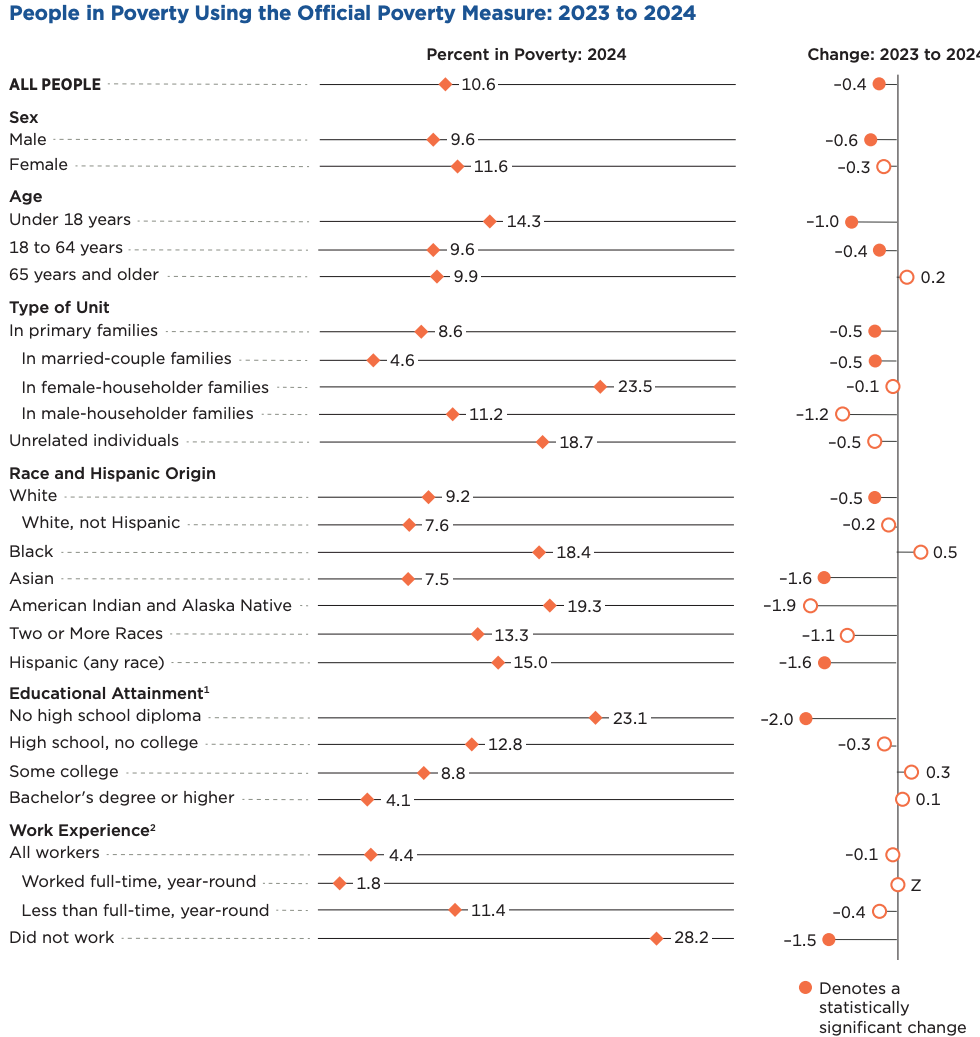
- Source: Poverty in the United States: 2024 Current Population Reports. Census.
[[Family poverty]]
- Low-income individuals suffer from structural vulnerability due to their deficient capital resources such as money, education, or important information.
- Structural vulnerability means they are more likely to encounter major difficulties or threats in life.
[[Health issues among poor children]]
- Poor children are more likely than their more affluent peers to suffer from a lengthy list of health problems.
- Health problems include:
- mothers’ inadequate prenatal care,
- low birth weight,
- high infant mortality,
- iron deficiency,
- high levels of toxic lead,
- risk of hunger and malnutrition, and
- elevated rates of heart disease, diabetes, hypertension, cancer, asthma, and dental problems.
- Poor children also face the sometimes hidden but debilitating anxiety created by:
- living in crowded, run-down spaces,
- chronic shortages of money
- fears of eviction,
- family dissolution, and
- random street violence.
[[Parental relations]]
- Poverty is associated with financial and psychological stresses that can affect parental behavior.
- Poor parents tend to be less nurturing, more authoritative, and administer harsher physical discipline than more affluent parents.
- Low-income families provide less intellectual stimulation to their children than more affluent families, even when other factors like parents' education and family structure are taken into account.
-
There is a significant difference in the amount of communication between parents and children across income levels.
-
Number of spoken words
- Parents in professional jobs use about 2,200 words per hour speaking to their children, while working-class parents average about 1,300 words per hour, and welfare parents use less than half the working-class figure, about 600 words.
-
-
The quality of parental relations can have a significant impact on a child's development and well-being.
- Poverty is a risk factor for lower-quality parental relations, which can exacerbate the effects of poverty on children's outcomes.
[[Significance of extended family members]]
- Researchers, social workers, and government officials often fail to appreciate the significance of extended family networks in poor single-parent families.
- Extended family networks refer to an interrelated kinship group that plays a role in members' care, particularly children's health and well-being.
- In poor single-parent families, aunts, uncles, cousins, and grandparents often make significant contributions to children's care.
[[Contributions of extended family members]]
- Grandparents, in particular, provide residences for children, especially during emergencies such as parents' illness, loss of job, or breakup of marriage or cohabiting relationship.
- When grandparents babysit, it frees parents to enter the job world and reduces costs for paid childcare.
- Extended family relations can be highly productive in pooling resources to keep members above the poverty level.
[[Vulnerabilities of poor single-parent families]]
- Certain parental traits increase the extent of their vulnerability, such as starting families in their teens or dropping out of school.
- Single-parent families, most of which are female-headed, are more than twice as likely to be living in poverty than American families overall.
- The majority of single-parent families receive no child support due to fathers' disappearance, commitment to new partners and children, or insufficient job skills and income.
- Poverty reduces the likelihood of marriage and the formation of an economically secure partnership, especially for men who commit less strongly to their partners and children without steady work.