Survey questions
Module items
Assignment
- Crafting questions
- See: [[How to submit an assignment]]
Sample assignment
Reading
Learning outcomes
- Explain why question wording affects survey answers
- Write short and clear survey questions
- Distinguish single-barreled and double-barreled questions
- Distinguish neutral and leading questions
- Match survey questions with useful response categories
- Use a checklist to revise weak survey questions
Why [[survey questions]] matter
- It is the main measurement tool.
- A good survey question helps every respondent:
- Understand the same thing,
- Remember or judge the answer in the same way, and
- Choose from response categories that fit what they want to say.
- If the question is unclear, the data will be unclear.
- Poor question wording makes respondents guess, skip the question, or quit the survey.
Writing [[survey questions]]
Rule 1: Write [[single-barreled questions]]
- A good survey question should be single-barreled:
- It asks about one thing.
- The respondent knows exactly what to answer.
- The researcher knows what the answer means.
- [[Double-barreled questions]] ask about two or more things at once.
-
This creates a problem because the respondent may agree with one part and disagree with another.
-
Single-barreled vs. double-barreled questions
-
Bad question Problem Good question How satisfied are you with your classes and professors? Classes and professors are not the same thing. How satisfied are you with your classes?
How satisfied are you with your professors?Do you support increasing tuition and improving campus services? A respondent may support services but oppose tuition increases. Do you support increasing tuition?
Do you support increasing funding for campus services?How often do you visit your mother and father? A respondent may visit one parent more often than the other. How often do you visit your mother?
How often do you visit your father?
-
-
-
Rule 2: Write [[short questions]]
- Short questions are easier to understand.
- [[Long questions]] create more room for confusion.
- A question can be too long when it:
- Includes unnecessary background information,
- Uses too many clauses,
- Asks the respondent to remember too many details at once, or
- Makes the respondent do a calculation in their head.
-
The goal is short and specific.
-
Short vs. long questions
-
Bad question Problem Good question Thinking about everything that has happened in your college experience, including your classes, professors, classmates, assignments, advising, and other campus experiences, how satisfied are you overall? Too much to hold in mind at once. Overall, how satisfied are you with your college experience? In the past 30 days, when you used public transportation, how often did you experience a delay of more than 15 minutes? Respondent must remember trips, delays, and calculate a frequency. In the past 30 days, how many times did you use public transportation?
How many of those trips were delayed by more than 15 minutes?Has it ever happened to you that over a long period of time you wanted to find a job but were not able to find one? Awkward and indirect. Have you ever been unemployed while looking for work?
-
-
Rule 3: Write [[simple questions]]
- Use words respondents already know.
- Avoid [[complex questions]]:
- Questions that include jargon, technical terms, and academic language.
- The question should sound like something any person can answer.
-
If a technical term is necessary, define it before asking the question.
-
Simple vs. complex questions
-
Bad question Problem Good question Does your household follow patriarchal decision-making practices? Uses academic language. Who usually makes major financial decisions in your household? How often do you engage in political participation? Too broad and abstract. In the past 12 months, have you voted, attended a public meeting, contacted an elected official, or joined a protest? Do you experience food insecurity? May not mean the same thing to everyone. In the past 30 days, did you ever skip a meal because there was not enough money for food?
-
-
Rule 4: Write [[specific questions]]
- Avoid [[vague questions]]:
- Questions that can mean different things to different people.
- A specific question gives respondents a clear frame of reference:
- Who?
- What?
- Where?
- During what time period?
-
Words like often, regularly, family, crime, healthy, and community can be interpreted in many ways.
-
Simple vs. complex questions
-
Bad question Problem Good question Do you exercise regularly? "Regularly" is vague. During the past 7 days, on how many days did you exercise for at least 30 minutes? Do you often talk to your neighbors? "Often" is vague. During the past month, how many times did you talk with a neighbor? Have you been a victim of crime? Respondents may define crime differently. In the past 12 months, has anyone stolen money or property from you?
-
-
Rule 5: Write [[neutral questions]]
- Neutral questions do not push the respondent toward one answer.
- [[Leading questions]] suggest that one answer is better, more moral, more popular, or more correct.
-
Leading questions weaken the survey because they measure reaction to the wording, not only the respondent's real opinion.
-
Neutral vs. leading questions
-
Bad question Problem Good question Do you agree that the university should finally fix the unfair parking system? Pushes the respondent toward agreement. Do you favor or oppose changing the university parking system? Should the city waste taxpayer money on a new stadium? Uses loaded wording. Do you favor or oppose using city funds for a new stadium? Do you support protecting innocent children by increasing school security? Builds an argument into the question. Do you favor or oppose increasing school security?
-
-
Rule 6: Write [[positive questions]]
- Questions with not can be confusing.
- [[Double negative questions]] are especially confusing.
- If respondents have to stop and decode the sentence, the question is too complicated.
-
A positive wording is usually clearer.
-
Positive questions vs. double negative questions
-
Bad question Problem Good question Do you agree that marijuana should not be illegal? Contains a confusing negative. Do you think marijuana should be legal? Should students not be allowed to skip advising? Hard to know what "yes" means. Should students be required to meet with an advisor? I do not feel unsafe on campus. Agree or disagree? Agreement means a positive feeling, but the wording is negative. How safe do you feel on campus?
-
-
Rule 7: Write appropriate [[response category|response categories]]
- The response categories are part of the question.
- Good response categories should be:
- [[Exhaustive]]: every respondent can find an answer that fits.
- [[Mutually exclusive]]: no respondent fits two answers at once.
- [[Balanced]]: positive and negative options are treated evenly.
- [[Ordered]]: if the categories have a scale, the order should be clear.
-
Response category examples
-
Rule Weak response categories Problem Better response categories Exhaustive What is your employment status?
Employed
UnemployedLeaves out students, retired people, homemakers, and disabled respondents. Employed
Unemployed and looking for work
Student
Retired
Not working for another reasonMutually exclusive What is your main way of getting to campus?
Drive alone
Carpool
Use a car
Take public transportationA respondent who drives alone or carpools also “uses a car,” so more than one answer can fit. Drive alone
Carpool
Public transportation
Walk
BikeBalanced How satisfied are you?
Very satisfied
Satisfied
Somewhat satisfied
Not satisfiedMostly positive categories. Very satisfied
Somewhat satisfied
Somewhat dissatisfied
Very dissatisfiedOrdered How often do you attend campus events?
Often
Never
Sometimes
RarelyThe scale is not in a logical order. Never
Rarely
Sometimes
Often
-
Rule 8: Avoid [[open-ended questions]]
- [[Open-ended questions]] let respondents answer in their own words.
- [[Closed-ended questions]] ask respondents to choose from a list.
- In surveys, closed-ended questions are better because they produce answers that can be compared across respondents.
- Open-ended questions are useful in the pilot stage:
- To learn how respondents think about the topic,
- To discover missing response categories, and
- To improve the final closed-ended question.
- Open-ended questions should usually not be used in the main survey.
- If 1,000 people answer in their own words, someone has to read, interpret, and qualitatively code those answers.
- That turns the survey back into qualitative analysis.
- If we want that kind of rich answer, a qualitative interview is usually the better method.
- "Other" may look like an easy fix, but it often signals that the response categories were not developed carefully enough.
- If many respondents choose "Other," the researcher still has to code those answers later.
- Also ask yourself: why did many respondents choose "Other"?
- If too many respondents choose "Other," then the response categories were not exhaustive.
- Also ask yourself: why did many respondents choose "Other"?
- If many respondents choose "Other," the researcher still has to code those answers later.
- A better strategy:
- Use open-ended questions during the pilot,
- Study the answers,
- Build stronger closed-ended response categories, and
- Remove "Other" from the main survey.
Example: "Other" category in practice
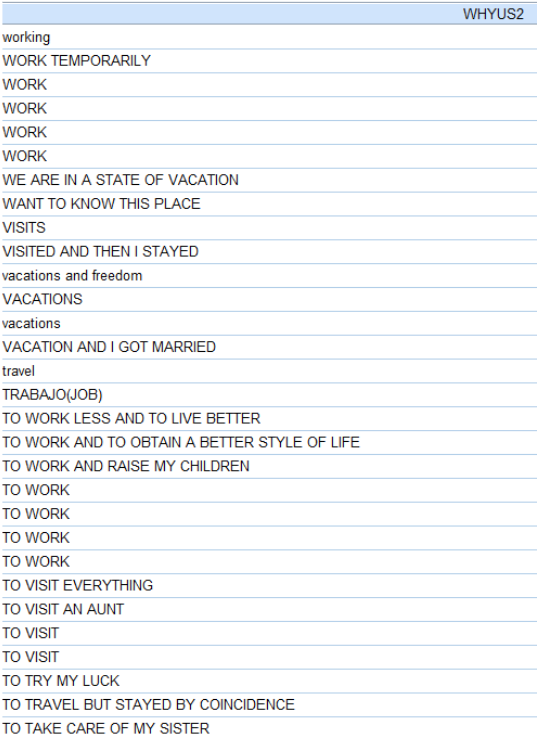
- In the Latino National Survey (2006), respondents were asked:
- What would you say is the main reason you came to live in the United States?
- Education
- Family reunification
- Escape political turmoil
- My parents brought me as a child
- Improve economic situation
- Other
- What would you say is the main reason you came to live in the United States?
- Many respondents who selected "Other" provided answers such as:
- "Work", "Work temporarily", "Employment".
- But "work" is very close to "improve economic situation."
- There is another problem:
- Some second-generation respondents said "work" because they were explaining why their parents migrated.
- But they should have selected "My parents brought me as a child."
- Some second-generation respondents said "work" because they were explaining why their parents migrated.
- This shows how "Other" can create confusion.